
Difference Between LLC and Corporation: What Business Owners Should Know
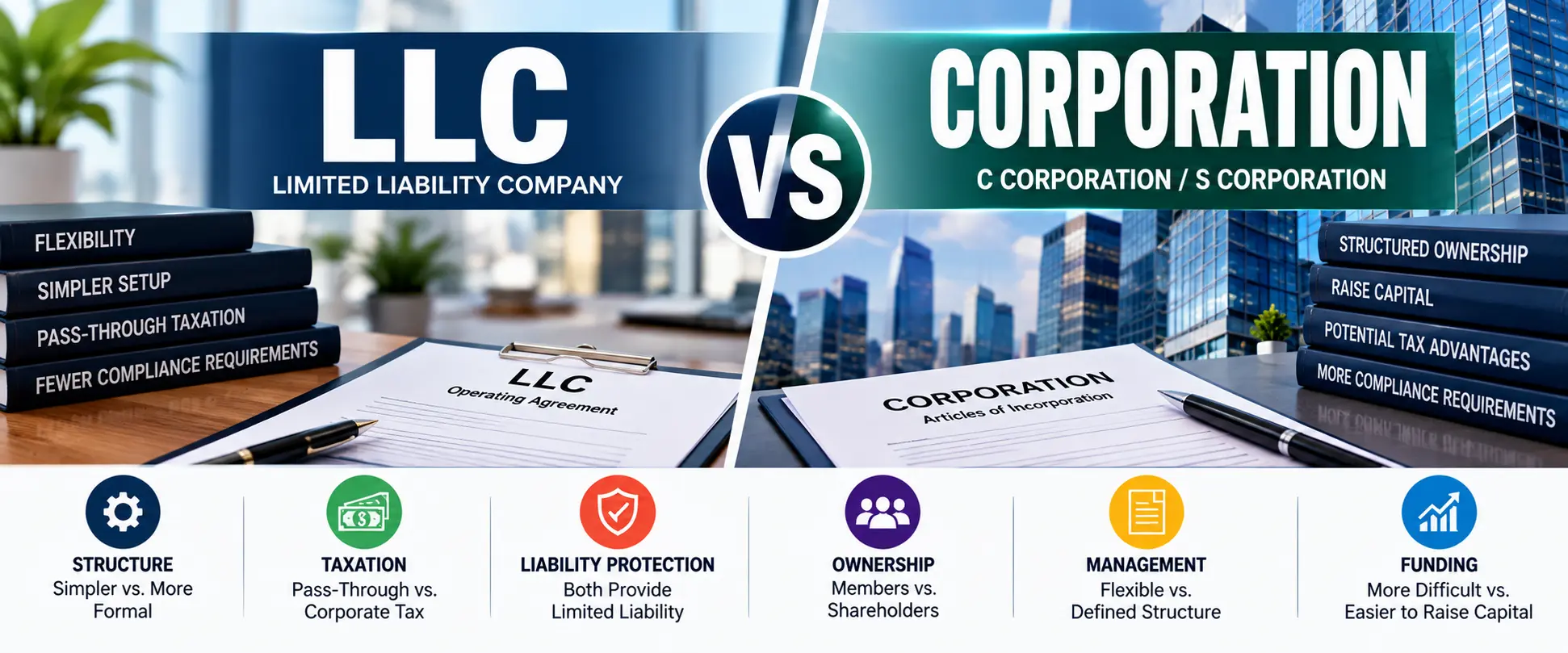
The difference between LLC and corporation structures mainly comes down to ownership, management, taxation, formal requirements, and the way a business can raise capital. However, they operate differently enough that choosing the right structure can affect how you run and grow your company.
For many entrepreneurs, the decision is not simply about which structure sounds more professional. Instead, it should reflect the number of owners, tax preferences, management style, financing plans, and long-term goals of the business.
Here is a practical look at how LLCs and corporations compare.
What Is an LLC?
It combines liability protection with a relatively flexible approach to ownership and management.
An LLC’s owners are generally called members. Depending on state law and the company’s structure, an LLC can have one member or multiple members.
One reason entrepreneurs choose LLCs is flexibility. Members can often manage the company themselves or appoint managers to handle daily operations.
Tax treatment can also be flexible. For federal income tax purposes, a single-member LLC is generally treated as a disregarded entity unless another classification is elected. Meanwhile, a multi-member LLC is generally taxed as a partnership unless it elects another eligible classification.
If you are new to this structure, understanding what is an llc and how does it work can make the tax and management rules easier to follow before comparing it with a corporation.
What Is a Corporation?
A corporation is a separate legal entity formed under state law. Shareholders own the corporation, while directors generally oversee major corporate decisions. Officers then handle the company’s daily management.
This separation creates a more formal structure than most LLCs use.
For example, corporations commonly have bylaws, directors, officers, shareholder meetings, stock records, and formal corporate resolutions. Specific requirements vary by state, yet corporations generally involve more structured governance.
A corporation is generally taxed as a C corporation unless it qualifies for and elects S corporation tax treatment.
Therefore, the word “corporation” does not automatically tell you how the business pays federal income tax.
Difference Between LLC and Corporation at a Glance
The easiest way to understand the difference between LLC and corporation structures is to compare their core characteristics.
| Feature | LLC | Corporation |
|---|---|---|
| Owners | Members | Shareholders |
| Management | Member-managed or manager-managed | Directors and officers |
| Liability protection | Generally yes | Generally yes |
| Default federal tax treatment | Depends on number of members | Generally C corporation |
| Ownership transfer | Depends on operating agreement and state law | Often easier through stock |
| Stock issuance | No traditional corporate stock | Can issue shares |
| Formalities | Generally fewer | Generally more |
| Outside investment | Possible, but structure may be less familiar to some investors | Often suited to equity investment |
| Governing document | Operating agreement commonly used | Bylaws commonly used |
| Best fit | Many small and closely held businesses | Businesses needing formal equity and governance structures |
These are broad differences. However, state law, tax elections, ownership arrangements, and company documents can change how an individual business operates.
What Is the Difference Between LLC and Corporation Ownership?
Ownership is one of the clearest distinctions.
LLC owners hold membership interests. Meanwhile, corporation owners hold shares of stock.
That difference affects how businesses bring in new owners and transfer ownership.
An LLC operating agreement can establish rules for admitting new members, selling membership interests, allocating profits, and making decisions. As a result, LLC owners can create a structure that matches their particular business relationship.
Corporations work through shares. Therefore, ownership percentages can be represented through stock holdings, while different classes of stock may carry different economic or voting rights when permitted.
For companies expecting several rounds of outside equity investment, the corporate model can be easier to scale.
Still, LLC flexibility can work particularly well for closely held businesses. Among the commonly discussed benefits of an llc are flexible management and the ability to choose from eligible federal tax classifications.
LLC vs Corporation: How Management Differs
An LLC usually offers greater freedom in designing its management structure.
For example, a small LLC with three owners may allow all three members to participate directly in operations. Alternatively, the members can appoint one or more managers.
The operating agreement can then explain responsibilities, voting rights, profit allocations, and procedures for major decisions.
A corporation follows a more defined hierarchy.
Shareholders elect directors. The board of directors oversees major business matters and appoints officers. Then, officers such as the president or chief executive officer manage operations.
This structure may feel excessive for a very small owner-operated company. However, as a business grows, clearly separated roles can help establish accountability and decision-making procedures.
How LLC and Corporation Taxes Compare
Taxation often causes the most confusion because an LLC’s legal structure does not determine a single federal tax treatment.
LLC Tax Options
By default, the IRS generally treats a single-member LLC as a disregarded entity for federal income tax purposes. Therefore, its activity is generally reflected on the owner’s applicable federal return.
Meanwhile, a domestic LLC with two or more members is generally treated as a partnership for federal income tax purposes unless it elects corporate treatment.
An eligible LLC can also elect to be taxed as a corporation. If it meets the requirements, it may later elect S corporation tax status.
This flexibility is one reason business owners sometimes research the difference between llc and s corp after initially forming an LLC.
Corporation Tax Treatment
A corporation is generally treated as a C corporation for federal income tax purposes unless it makes a valid S corporation election.
A C corporation generally pays federal corporate income tax on its taxable income. Then, shareholders may owe tax when the corporation distributes taxable dividends, creating the possibility of two levels of taxation.
An eligible S corporation generally uses pass-through taxation instead. Therefore, qualifying income, deductions, losses, and credits generally pass through to shareholders according to applicable rules.
For owners deciding specifically between pass-through options, an s corporation vs llc comparison can provide a more focused look at how legal structure and tax elections interact.
Difference Between LLC and Corporation for Liability Protection
Both LLCs and corporations generally provide limited liability protection.
This means owners are typically not personally responsible for business debts and obligations merely because they own the company.
However, liability protection is not absolute.
For example, an owner may still face personal liability for personal wrongdoing or certain personally guaranteed obligations. Courts can also disregard an entity’s separate status in some circumstances when legal requirements are seriously abused.
Therefore, business owners should keep company and personal finances separate, maintain proper records, sign contracts in the company’s name, and follow applicable state requirements.
Good business practices support the legal separation the entity was designed to create.
Which Structure Has More Administrative Requirements?
LLCs are generally known for lighter administrative requirements, although the exact rules vary by state.
An LLC commonly needs to file formation documents, maintain required registrations, pay applicable fees, and comply with state reporting rules. A well-drafted operating agreement can also clarify how the company will operate.
Corporations generally require more formal governance.
For instance, a corporation may need to maintain bylaws, document shareholder and director actions, keep stock records, and follow meeting or consent requirements under applicable law.
These requirements can create extra work. On the other hand, formal governance can become useful as a company adds shareholders, executives, and investors.
A balanced review of corporation advantages and disadvantages can help owners decide whether this extra structure supports or complicates their business plans.
Raising Money: LLC or Corporation?
Funding strategy can strongly influence the choice.
An LLC can raise money by bringing in new members, borrowing funds, or using other financing arrangements. However, some professional investors prefer corporations because corporate stock and governance structures are widely used in equity financing.
A corporation can issue shares to investors and, depending on its structure, may issue different classes of stock.
That flexibility can become valuable for a startup planning to seek venture capital.
Imagine two new businesses.
The first is a family-owned marketing agency. Its three owners expect to manage the company themselves and do not plan to seek institutional investors. An LLC may provide the flexibility they want.
The second is a software startup whose founders expect to raise several financing rounds from outside investors. A corporation may fit that growth strategy more naturally.
Therefore, financing goals should be considered before formation rather than after investors arrive.
Difference Between LLC and S Corporation
The difference between LLC and S corporation requires a slightly different explanation because these terms describe different concepts.
An LLC is a legal entity formed under state law. An S corporation, by contrast, is primarily a federal tax status that eligible corporations and LLCs may elect.
This distinction often surprises new entrepreneurs.
For example, an owner may form an LLC because of its flexible legal structure. Later, if the business qualifies, the LLC may elect S corporation tax treatment.
Therefore, choosing an LLC does not necessarily eliminate S corporation taxation as a future option.
When an LLC May Make Sense
An LLC may appeal to owners who want liability protection without adopting a traditional corporate governance structure.
For instance, it can work well for consultants, local service businesses, agencies, real estate ventures, family businesses, and many other closely held companies.
An LLC may be worth considering when:
- Owners want flexible management.
- The company has a small number of owners.
- Traditional corporate stock is unnecessary.
- Owners want flexibility in eligible tax classifications.
- Simpler internal governance is preferred.
However, owners should still evaluate state fees, taxes, licenses, and reporting requirements before forming the entity.
When a Corporation May Make Sense
For example, a corporation may fit a business that expects to issue stock, attract outside equity investors, establish different stock classes, or build a larger ownership base.
A corporation may be worth considering when:
- The business expects significant outside investment.
- Founders want ownership represented through shares.
- Multiple stock classes may be useful.
- Formal board governance supports the growth plan.
- The company expects ownership to change over time.
However, owners should weigh these advantages against increased administrative responsibilities.
Common Mistakes When Choosing a Business Structure
One mistake is choosing an LLC simply because someone says it is easier.
Ease matters, yet the structure should support the company’s future goals.
Likewise, forming a corporation just because the business plans to grow can create unnecessary administration if stock-based financing and formal governance are unlikely to be needed.
Another mistake is confusing legal structure with tax classification. An LLC may have several possible federal tax treatments, while an eligible corporation can elect S corporation status.
Business owners also sometimes ignore state-specific rules. Formation fees, annual reports, franchise taxes, filing requirements, and other obligations can vary significantly by state.
Finally, owners may focus only on today’s needs. A company that plans to seek investors in two years should consider that goal when choosing its structure now.
FAQs About LLCs and Corporations
Is an LLC the same as a corporation?
No. An LLC and a corporation are separate legal structures under state law. Although both can provide limited liability protection, they differ in ownership terminology, governance, formalities, and other areas.
Is an LLC always taxed differently from a corporation?
No. LLC tax treatment depends on the number of members and any tax elections made. An eligible LLC can elect corporate taxation and may also qualify to elect S corporation status.
Can an LLC issue stock?
An LLC does not issue traditional corporate stock. Instead, its owners hold membership interests according to the company’s governing documents and applicable state law.
Which is easier to manage?
An LLC generally offers more management flexibility and fewer traditional corporate formalities. However, the practical difference depends on state law and the complexity of the business.
Can you change from an LLC to a corporation later?
Businesses can often restructure, convert, or complete other transactions to change their legal form, depending on state law. However, conversions can have legal and tax consequences, so professional guidance may be appropriate before making the change.
Choosing a Structure That Fits Your Business
Understanding the difference between LLC and corporation structures becomes easier when you focus on what your company actually needs.
If flexible management and fewer corporate formalities are priorities, an LLC may deserve serious consideration. Meanwhile, if the company expects stock-based investment, multiple shareholders, or formal board governance, a corporation may provide a more suitable framework.
Before filing formation documents, consider ownership, taxes, management, financing, state requirements, and your long-term growth plan together. Then, when the financial or legal consequences are significant, discuss your situation with a qualified accountant, tax professional, or business attorney. The right structure should support how the company operates today while leaving room for where you want it to go next.